
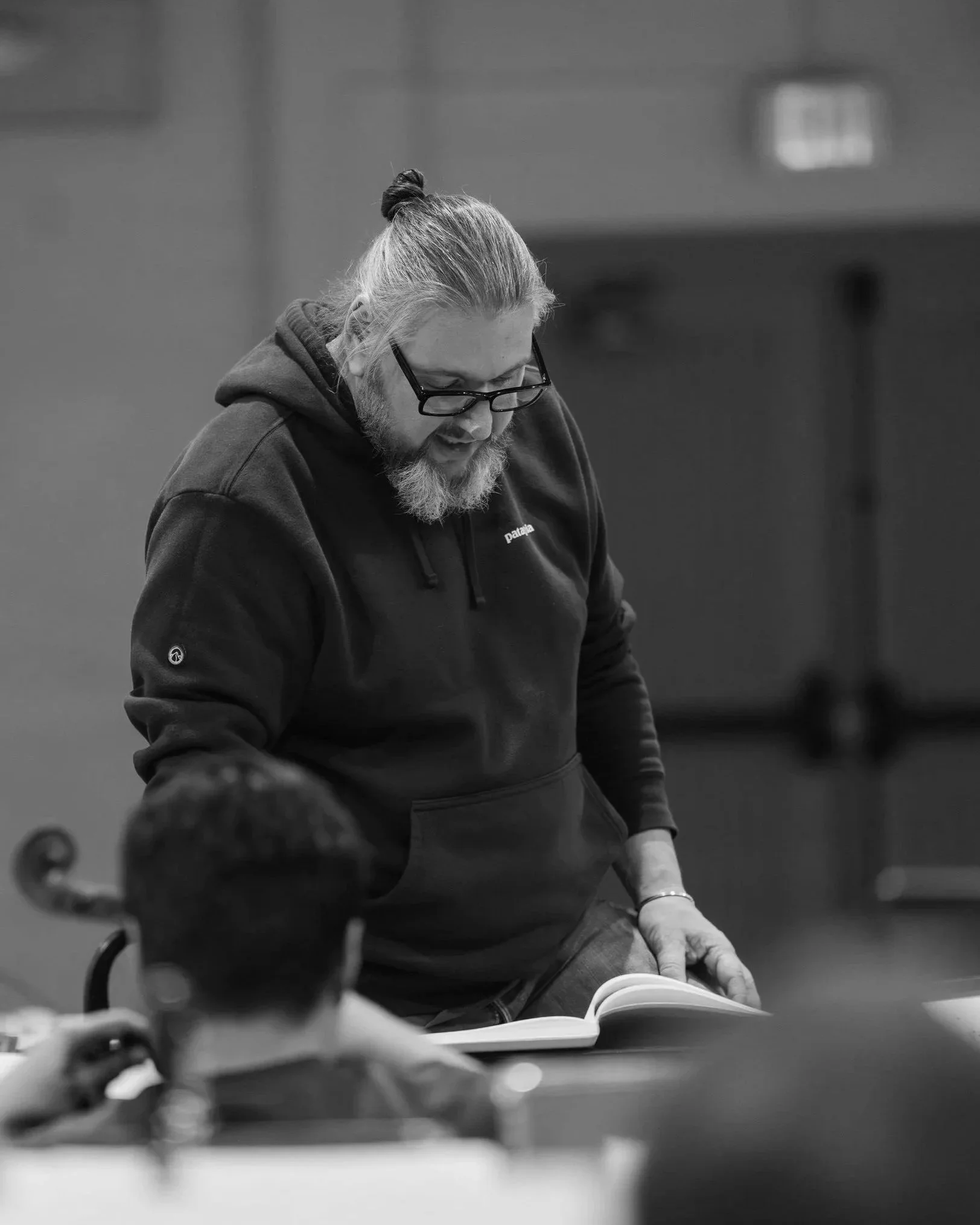
His conducting repertoire spans more than three centuries and includes Bach’s Brandenburg Concertos; Beethoven’s Third, Fifth, Sixth, Seventh and Ninth Symphonies; Brahms’ First, Second and Fourth; Mozart’s Jupiter and PragueSymphonies; and Tchaikovsky’s Fourth and Fifth, alongside major orchestral works by Bruckner, Mahler, Richard Strauss, Bartók, Britten, Debussy, Elgar and Prokofiev. His symphonic-choral repertoire includes Beethoven’s Missa Solemnis, Bach’s St. John Passion and Christmas Oratorio, Brahms’ Ein deutsches Requiem, Verdi’s Requiem and Orff’s Carmina Burana.
Biography
Daniel Henriks first stepped onto the podium at the age of thirteen. More than twenty-five years later, his career has taken him to opera houses, concert halls, and festivals throughout Europe and the United States, first as a conductor, then as a dramatic baritone, and today once again as a conductor.
He studied conducting and voice in Germany before earning his Master of Music from The Juilliard School in New York.
Before devoting himself fully to conducting, Daniel built an international career as a dramatic baritone, performing leading roles at many of Europe's distinguished opera houses. His repertoire centered on Verdi, Wagner, Puccini, Strauss, and the great dramatic works of the nineteenth and twentieth centuries.
Today, his work spans opera, orchestra, and chorus. As Music Director of I Cantori di Carmel and founder of Opera Carmel, he is committed to programming that places masterworks alongside lesser-known repertoire and contemporary voices.
For Daniel Henriks, conducting has never been about standing in front of an orchestra giving cues. It is about bringing together dozens of accomplished musicians, each with their own ideas, instincts, and artistic voice, and creating the conditions in which they listen, trust, challenge, and inspire one another. "You create an environment where experts in their own right can shine," he says. "I want opinionated musicians. I want people to bring something to the table." For Daniel, music is a language, not an act of execution.
That philosophy has been shaped by a lifetime spent on both sides of the musical conversation. Daniel began conducting at the age of thirteen, embarking on a career that would take him to orchestras, opera companies, and concert halls throughout Europe and the United States. Alongside his work on the podium, he built an international career as a baritone, performing leading roles at many of Europe's distinguished opera houses. Living both perspectives, as conductor and singer, has profoundly influenced the way he approaches rehearsal, collaboration, and performance.
For Daniel, every score is an ongoing conversation rather than a finished answer. Great music reveals itself slowly, returning something new each time it is studied or performed.
His favorite moments rarely happen in performance. They happen in rehearsal, when the technical work disappears, an orchestra begins to breathe together, and, as he describes it, "it starts to speak."
Whether conducting opera, symphonic repertoire, or choral music, Daniel believes a performance is never a one-way experience. Music is an exchange between composer, performer, and audience, each shaping the other in ways that cannot always be explained.
“Music is a language, not an act of execution.”